Scaling Your Agency: The Ultimate Guide to White Label SEO Services
If you’ve spent any time running a marketing agency, you’ve likely hit “The Ceiling.” You know exactly what it feels like: you’ve landed a few solid clients, your team is working at 110% capacity, and suddenly you’re too busy putting out daily fires to actually grow your business. You want to scale, but hiring more full-time staff feels like a massive financial gamble. If you hire before the next contract is signed, your margins vanish; if you wait too long, your service quality drops and your current clients start looking at the exit.
This is where the agency model is fundamentally shifting. In 2026, the most successful firms aren’t necessarily the ones with the biggest offices or the most flashy awards they are the ones with the smartest partnerships. Specifically, they are leveraging White Label SEO Services to handle the heavy lifting while they focus on high-level strategy and client relationships. This shift allows an agency to move from being a “worker” in the business to being the “architect” of a growth machine.
What White Labeling Really Means for Your Bottom Line
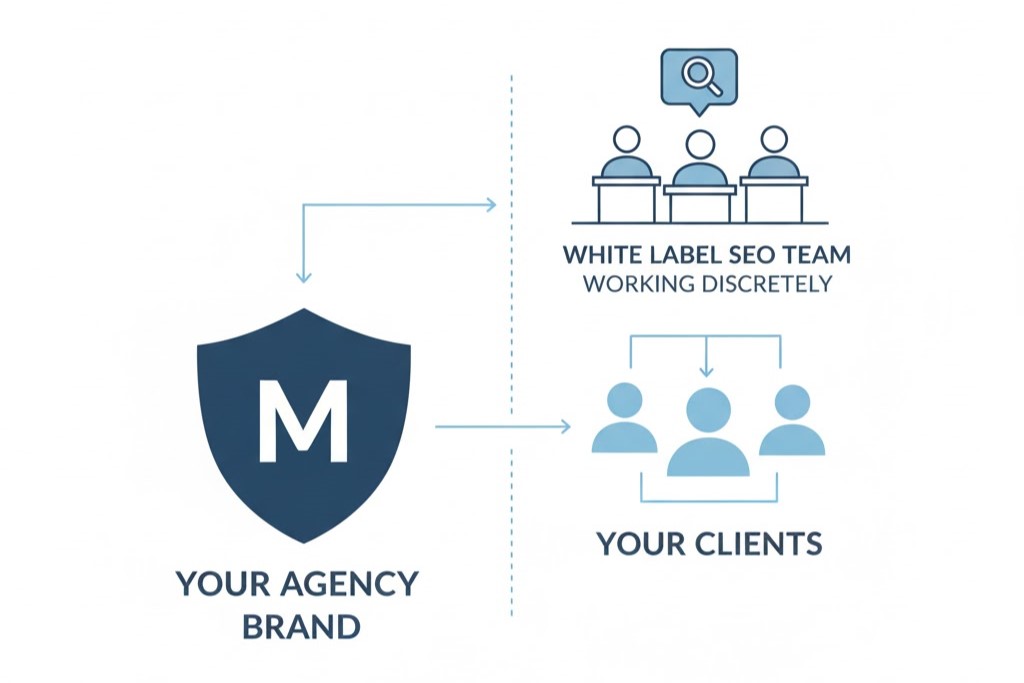
At its core, white labeling is a partnership of expertise. You sell the service under your brand, and a specialized provider the “white labeler” executes the work behind the scenes. Think of it like a high-end restaurant: the chef doesn’t necessarily grow the heirloom tomatoes or raise the cattle, but they source the best ingredients from specialized farms to create a world-class meal. The customer pays for the chef’s vision and the restaurant’s experience, but the quality is backed by a chain of specialists.
By using these services, you are essentially hiring a “plug-and-play” department. You get the benefit of their proprietary tools, their years of accumulated data, and their specialized technicians without the $100k/year overhead of a single senior hire. In the US market, where talent costs are skyrocketing, this isn’t just a convenience it’s a competitive necessity. It allows you to maintain a lean, agile core team while offering the capabilities of a massive, full-service firm.
Why SEO and Content Marketing Services are Inseparable
You can’t talk about SEO today without talking about content. In the early days of the web, you could “trick” a search engine with technical hacks and keyword stuffing. Today, Google is essentially a “human behavior” engine. It wants to see that you are providing genuine value, which is why your strategy needs a pulse.
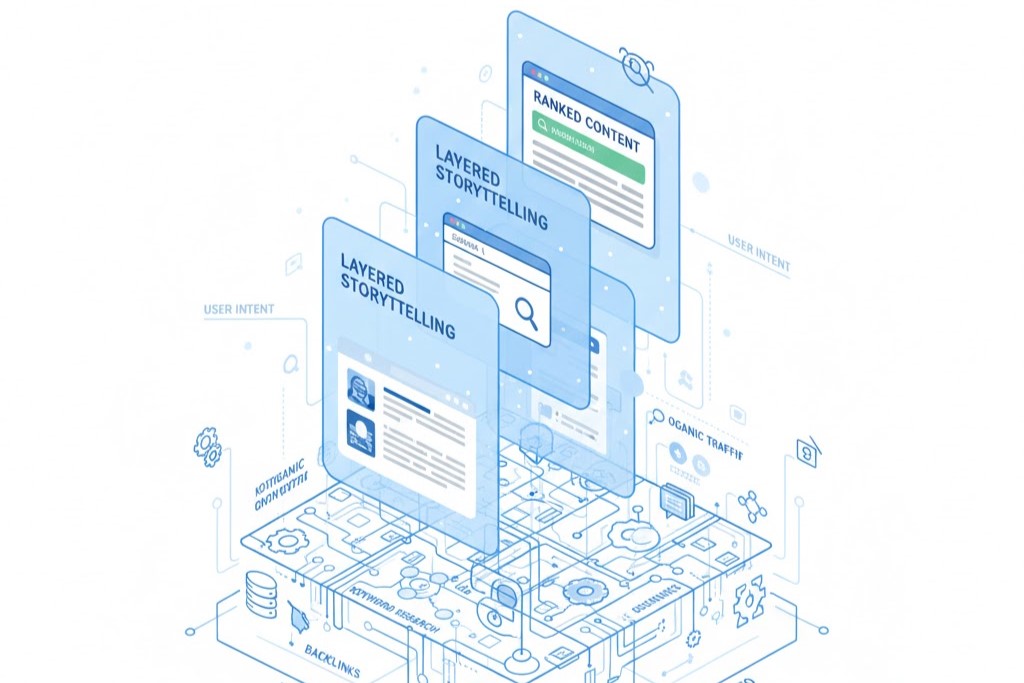
When you look for a partner, you aren’t just looking for someone to tweak meta tags. You need a team that offers integrated Content Marketing Services. SEO acts as the skeleton the technical structure, the site speed, and the keyword map while content acts as the muscle. It’s the blog posts, white papers, and landing pages that actually convince a human to trust the brand. If you offer one without the other, you’re only giving your client half a solution. A beautiful website that ranks #1 but has terrible writing won’t convert; conversely, the best article in the world is useless if no one can find it. White labeling allows you to bridge that gap perfectly.
The Technical Depth of Professional White Label SEO
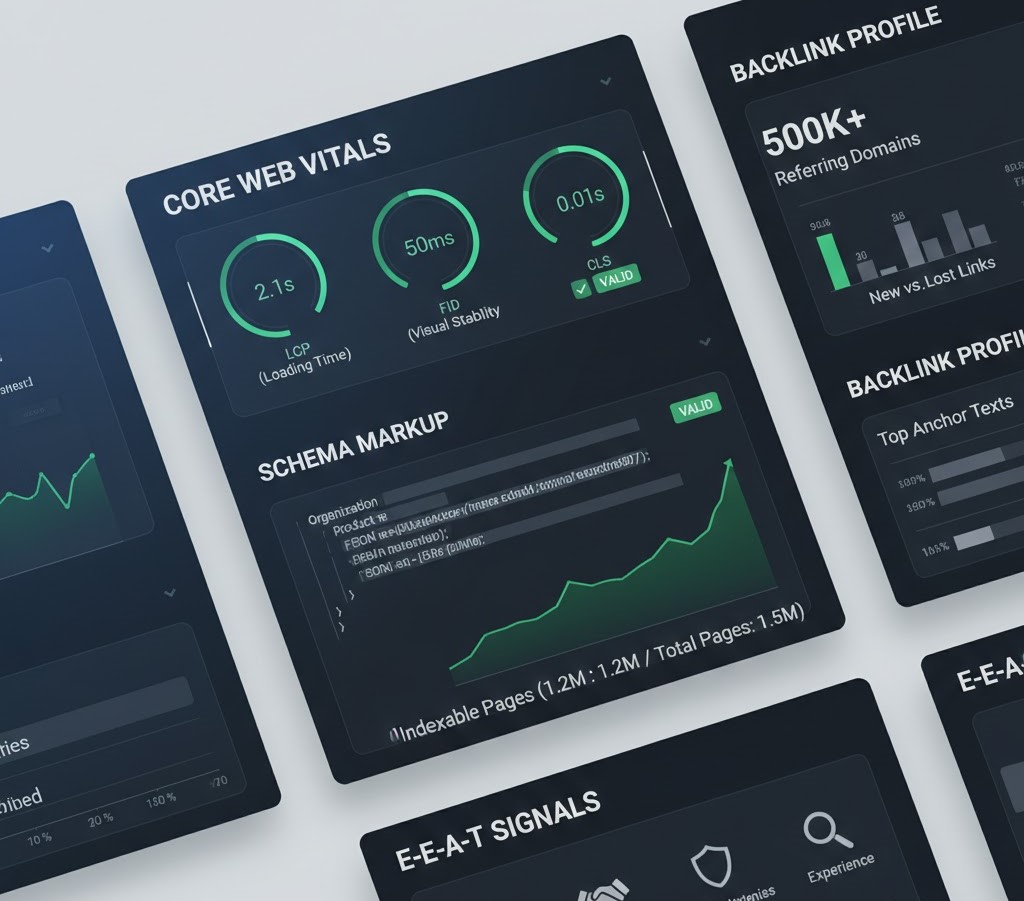
Most agency owners shy away from high-level SEO because the “technical” side is a moving target. Google updates its algorithm thousands of times a year. Staying on top of “Core Web Vitals,” “Schema Markup,” and “E-E-A-T” (Experience, Expertise, Authoritativeness, and Trustworthiness) is a full-time job. It’s not something you can expect an account manager to do in their spare time.
A professional white-label partner provides comprehensive audits that go beyond what a free PDF tool can generate. They perform manual deep-dives into why a site isn’t converting, looking at everything from server response times to JavaScript rendering issues. Perhaps most importantly, they handle link earning. This is arguably the hardest part of SEO in 2026. It requires a massive network of journalists, editors, and bloggers that a provider spends years building. When you partner with them, you aren’t just buying links; you’re buying access to that hard-earned reputation.
Scaling Content Without the Creative Burnout
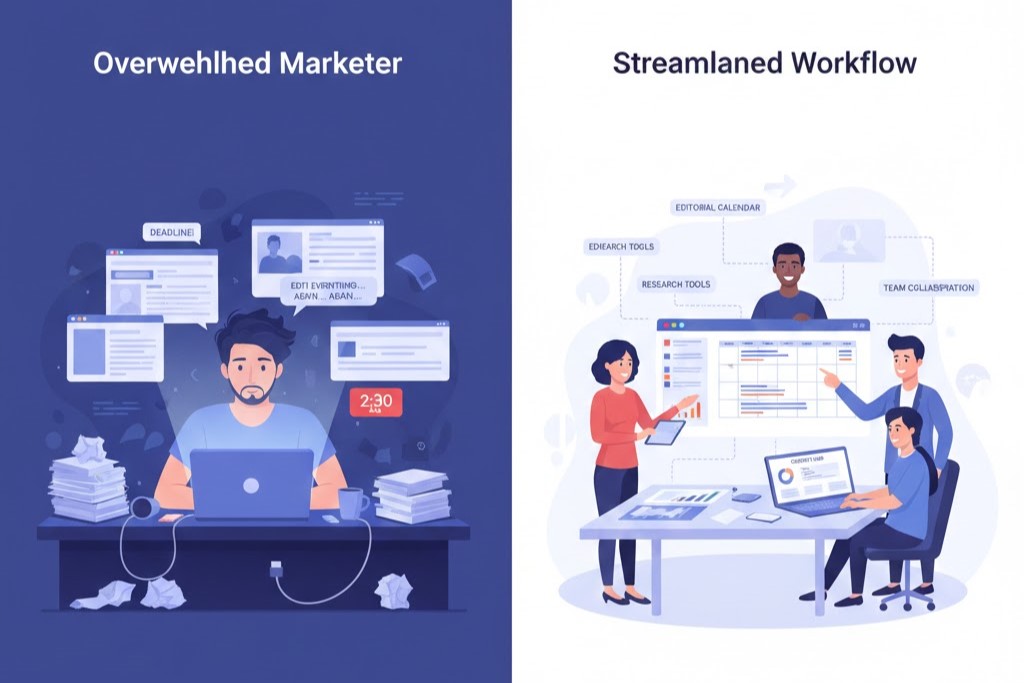
Content is notoriously hard to scale because it is intrinsically human. Good writers are expensive, and cheap writers usually produce work that you end up having to rewrite yourself. This is the “agency trap” spending five hours editing a freelancer’s $50 blog post only to realize you could have written it faster yourself. It’s an exhausting cycle that leads to burnout and high staff turnover.
By utilizing professional content services through a white-label model, you get a formalized process. This includes data-backed topic research to see what people are actually searching for, rather than just guessing. It also ensures a “funnel” approach, creating content for every stage of the buyer’s journey. This means producing educational blogs that build awareness at the top, and case studies or “why buy” guides that finally close the sale at the bottom. The goal is to create an ecosystem of information that guides a stranger toward becoming a customer without them ever feeling like they’re being “sold” to.
The Economics of the Lean Agency Model
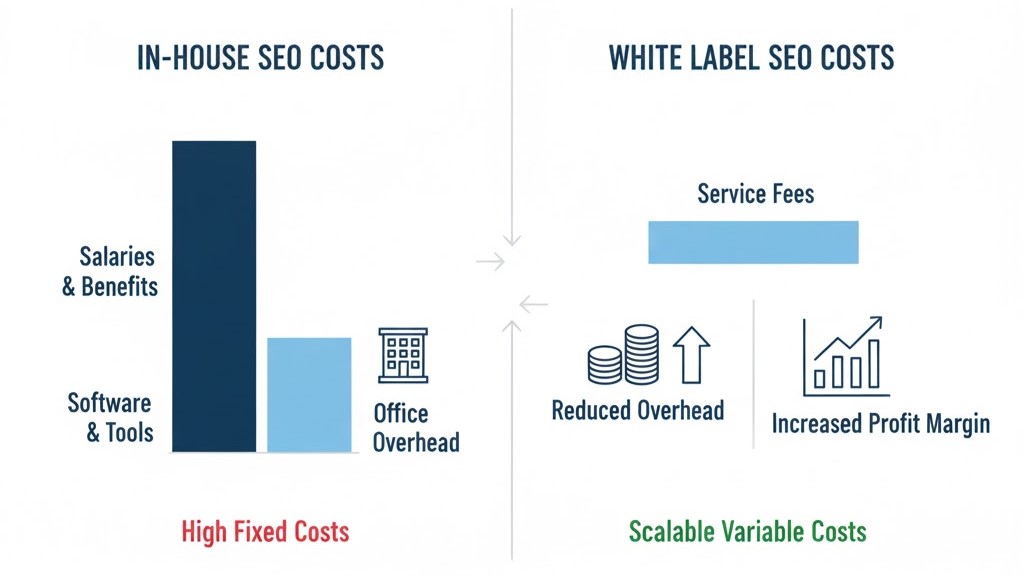
Let’s look at the math, because this is usually where the lightbulb goes on for agency owners who are stressed about their margins. In an in-house model, you might hire an SEO Manager and a Content Strategist. Between salaries, health insurance, taxes, and software seats for tools like Ahrefs or Semrush, you’re likely spending $15,000 to $20,000 a month just to have the department exist. To make a profit, you have to charge your clients a massive premium. If you lose one or two clients, those salaries become a “sinkhole” for your cash flow, and you’re forced into a cycle of desperate hiring and firing.
In the white-label model, you pay your provider on a per-client basis. If you have ten clients, you pay for ten. If you lose one, your costs immediately drop for the following month. This flexibility allows you to offer affordable Digital Marketing Services to your clients while maintaining a healthy 50% or 60% margin for your agency. Your risk is virtually zero because your costs scale exactly with your revenue. This “elasticity” is what allows small agencies to weather economic downturns that often crush larger, high-overhead firms.
How to Vet a Partner Without Getting Burned
The market is flooded with low-cost providers who use “Black Hat” tactics shady shortcuts that can get your clients banned from search results overnight. If you’re going to put your brand’s reputation in someone else’s hands, you need to be incredibly picky. You aren’t looking for a vendor; you are looking for a back-office partner.
The first test is communication: do they have a dedicated account manager you can actually hop on a call with? If they only communicate via a faceless ticketing system or automated emails, that’s a massive red flag. You should also check their own website and presence. If their own SEO is poor or their content is boring and robotic, they won’t be able to do any better for your clients. Finally, look for transparency. Do they provide reports that you can put your logo on, and do they show you exactly what they did? If their process feels like “magic” or they tell you to “just trust us,” it’s time to walk away.
Integrating PPC for the Instant Win
While SEO and Content are the long-term plays, many clients want results yesterday. This is where you can upsell pay per click Services USA. The smartest agencies use PPC as a “scout” for their SEO strategy. Instead of guessing which keywords will convert, you run ads for 30 days to see which terms actually lead to phone calls and sales.
Once you have that data, you hand it over to the SEO and Content teams to build long-term, organic authority around those winning terms. This “Smarter, Not Harder” approach makes you look like a genius in your client’s eyes because you aren’t just asking for a budget; you’re using actual spending data to drive their long-term strategy. It creates a feedback loop where every dollar spent on ads informs the content that will eventually drive free traffic for years to come.
Managing the Client Relationship and Expectations
A common fear among agency owners is: “What if my client finds out I’m using a partner?” In reality, the modern client is much more savvy than we give them credit for. They don’t care who is pulling the levers as long as the results are showing up in their bank account. In fact, many clients prefer knowing you have a specialized team of experts backing you up rather than one overworked “generalist” trying to do everything from coding to copywriting.
You are the “General Contractor.” You handle the vision, the communication, and the strategy. Your partners are the specialized craftsmen who execute the build. The key is to own the strategy you should be the one presenting the reports and explaining the “why” behind the numbers. When you show the client how your White Label SEO Services are directly contributing to their growth, you become an indispensable partner in their business, not just another line item on their expense sheet.
Overcoming the "Cookie-Cutter" Content Problem
One of the biggest complaints with outsourced content is that it lacks “soul.” It feels generic because the writer doesn’t know the client’s business. A high-quality humanized partner solves this by using an onboarding process that actually interviews the client or the agency to capture the brand’s unique voice and “unspoken” expertise.
The goal of content in 2026 isn’t just to rank; it’s to demonstrate Experience. Google’s updated quality guidelines specifically look for “first-hand” knowledge. This is why a good partner will ask for bullet points or voice notes from the client to turn into a polished, professional article. It combines the client’s industry secrets with the partner’s writing and SEO skill. This is how you produce 1,500-word guides that people actually want to read, rather than 500-word blurbs that everyone ignores.
The Future of the Agency Model
The era of the 50-person agency with a massive downtown lease, a stocked bar, and a dozen junior account managers is fading. The future belongs to the “Lean Agency” a small, elite team of strategists who leverage a global network of specialists. This model is more resilient; it allows you to survive economic shifts because your overhead is flexible. It also allows you to scale up for a massive new client in 24 hours without having to post a single job opening or conduct a single interview.
Choosing a partner model means you are choosing growth over busy-work. By selecting high-quality SEO and integrated content strategies, you’re not just outsourcing work you’re buying back your time. You provide the brand, the vision, and the client care, while your partner provides the technical engine. When everyone plays to their strengths, the results speak for themselves. You can finally stop worrying about the “how” and start focusing on the “who” the clients you want to serve and the brand you want to build.