Building powerful digital marketing campaigns in Boston means a lot more than launching advertisements. Most local companies make mistakes in ways that weaken performance and waste budgets. In this blog, you’ll learn how Boston brands can avoid the most damaging Google Ads errors while aligning their efforts with insights often supported by the PPC management company Boston MA team.
Most firms use general keywords because they assume they yield high exposure; this often leads to invalid clicks. If location-based intent is not considered, ads could be shown to people outside one’s target market. Another problem is relying on generic phrases rather than search terms representative of actual buyer intent.
Another mistake many businesses in Boston make is forgetting to use long-tail and local modifiers, thereby putting themselves in competition with national brands. Competition increases costs per click, and campaigns siphon budgets without delivering any conversions.
A prevalent cause, however, of low return on investment is some form of mismatch in the audience. Many brands run campaigns in Boston without narrowing demographic, interest, and behavioural segments. Ads eventually reach users who are very unlikely to buy them.
Another targeting issue is the neglect of remarketing opportunities. When businesses don’t re-engage past visitors or warm leads, they leave behind possible conversions that could have been captured with strategic remarketing layers.
One common mistake brands make is writing generic ad copy without adding in any local context. Consumers in Boston often respond to ads that reference their city, neighbourhoods, or seasonal trends.
Some businesses also do not match the ad language to keyword intent. For example, search queries with “near me” expect location cues in the ad text. If the copy lacks this alignment, users skip the ad even if the keyword match is correct.
Some companies in Boston run a single ad version and bank on consistency, but because they don’t test different versions, they miss high-performing message angles. A/B testing is crucial to improving click-through rate and relevance.
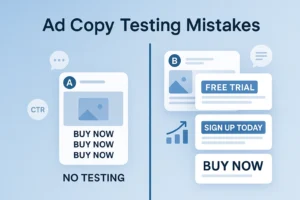
Others run too many variations at once without giving Google enough time to collect data. These lead to inconclusive results and less accurate optimisation decisions.
Negative keywords are crucial in keeping the campaigns efficient; however, most businesses in Boston fail to update them. Without filters, ads show up for irrelevant searches, resulting in wasted clicks.
Yet another issue is forgetting to refresh the negative keyword list on a regular basis. While trends and variants continue to emerge, so too must the list. When companies neglect doing this, poor-quality traffic increases while conversion rates dwindle.
Some businesses feel a need for control by sticking to manual bidding. Without deep expertise, manual bidding often limits reach and efficiency. Various automated strategies, when correctly set up, can produce superior results, including target CPA, maximise conversions.
Other mistakes include the too-frequent change of a bidding strategy. The automated systems need some time to learn about users’ behaviour. Continuous changes disturb the algorithm and degrade performance.
Many companies begin running campaigns without ever properly setting up conversion tracking. With incomplete monitoring, businesses cannot identify which keywords or ads actually drive leads; thus, optimisation becomes almost impossible.
Others apply last-click attribution solely and ignore the value of all other previous touches that occur in your customer journey. Without multi-touch insights, brands don’t understand which parts of the funnel need fixing.
Search intent is essential to any successful Google Ads campaign. A number of businesses in Boston use misleading keywords that do not reflect the customer’s mindset. Ads related to commercial intent tend to disappoint searchers looking for information and not services.
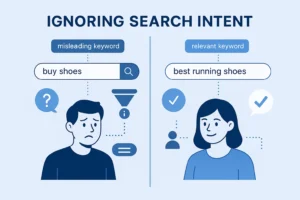
It also makes campaigns less structured by failing to categorise keywords into informational, navigational, and transactional clusters. Without proper grouping, ad relevance drops significantly.
They offer more information and increase visibility; however, a lot of the companies in Boston use them irregularly. Missing sitelinks, callouts, or location extensions result in unfinished-looking ads compared to competitors.
Some of them also repeat similar information in different extensions, which is a waste of space that could highlight the USPs, pricing, or service features.
The problems of budgeting usually begin with improper distribution in accordance with performance. Some companies in Boston assign equal budgets to all campaigns regardless of which particular ones create conversions.
Another mistake is failing to adjust budgets during peak seasons. During periods of higher demand, fixed monthly spending limits will result in lost opportunities and lower impression share.
Most companies actually split up the functions of paid search and organic search, which causes inconsistencies in messaging and missed keyword opportunities. When combined, insights from each can empower a brand to maintain consistent targeting and improved visibility.
Neglecting organic search data from a Google Ads campaign can lead to investing in keywords for which the company already organically ranks. Merging the power of paid search with the intelligence of SEO Services Boston MA, allows for more strategic planning.
Quality Score affects the ad cost, ranking, and visibility. However, this metric is mostly ignored by most advertisers. Poorly structured campaigns, low relevance of ads, and slow landing pages are just some major contributing factors that bring down the scores.

Another error is not reviewing Quality Score trends every month. Without regular monitoring, advertisers miss the chance to make minor adjustments that bring long-term savings.
Some businesses in Boston don’t use competitor insight at all. That understanding of what local companies are bidding on helps to recognise gaps or saturation areas.
Another common mistake is not regularly updating competitor analysis. The trends in the digital world change very fast, and to stay at the edge, they require monthly monitoring.
By evading these major mistakes in Google Ads, businesses in Boston can create much more specific targeting, better landing pages, more innovative bidding strategies, and closer connections to organic searches, the definitive signs that define the best-performing ad sets. If a brand sets up a well-structured paid search campaign and monitors its performance regularly, then it can avoid wasted spend for more successful paid search outcomes.
One of the most common problems is overspending on broad, irrelevant key terms. This leads to draining ad budgets.
It helps to enhance relevance by using Boston-specific modifiers and localised copy that will attract higher-quality traffic.
When landing pages reflect the promise of the ad, users will convert more, boosting campaign ROI.
Yes, if set up correctly, automated bidding optimises performance and saves a lot of manual work.
Weekly reviews are ideal for assessing trends, adding in negative keywords, and optimising spending.

We work with some really amazing businesses and organisations. Here are a few