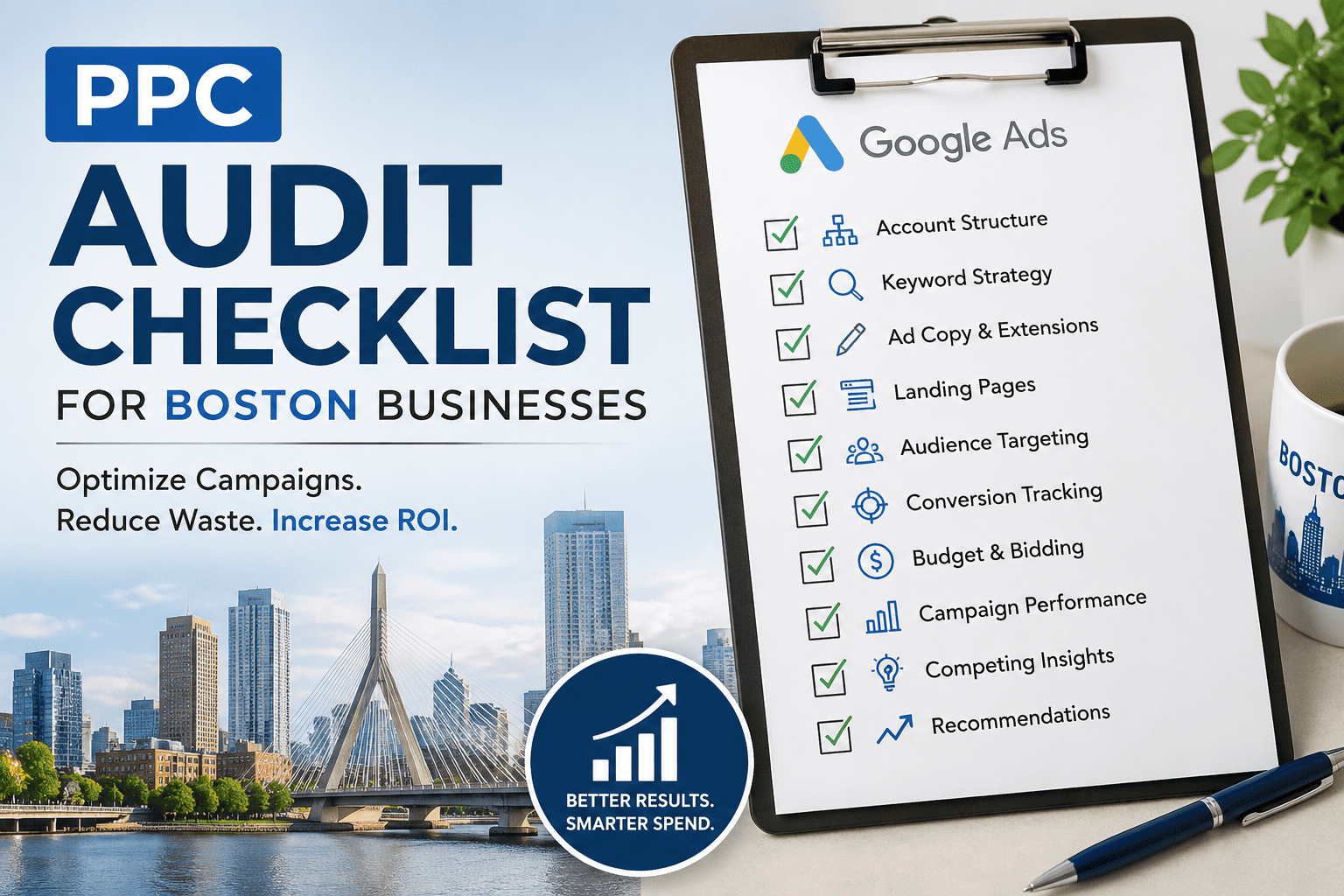
A PPC audit is a structured review of a pay-per-click advertising account. It helps identify strengths, weaknesses, wasted ad spend, and opportunities for improvement. A complete audit examines campaign settings, keywords, advertisements, landing pages, conversion tracking, and performance data.
For businesses evaluating PPC management Services Boston, understanding how a PPC audit works is valuable because it provides a clear picture of campaign performance before making strategic decisions. An audit is not about finding a single problem. Instead, it evaluates how different parts of a campaign work together to support business goals.
This guide explains what a PPC audit includes, why it matters, how to perform one, and the checklist businesses can use to review their own advertising campaigns.
A PPC audit is a detailed review of every important part of a paid advertising account.
The purpose is to answer questions such as:
Is the campaign meeting its goals?
Is the advertising budget being used efficiently?
Are keywords relevant?
Are conversions being tracked correctly?
Are advertisements attracting qualified visitors?
The audit identifies both technical issues and strategic improvements.
Advertising platforms change regularly.
Customer behavior also changes over time.
Without regular reviews, campaigns may:
Spend money on low-value clicks.
Miss valuable keyword opportunities.
Show outdated advertisements.
Generate fewer conversions.
Routine audits help businesses make informed decisions based on current performance rather than assumptions.
The ideal schedule depends on campaign size and complexity.
General guidelines include:
| Campaign Type | Suggested Audit Frequency |
|---|---|
| Small campaigns | Every 3–6 months |
| Medium campaigns | Every quarter |
| Large campaigns | Monthly reviews with quarterly audits |
| New campaigns | Within the first 30–60 days after launc |
Regular reviews make it easier to identify problems before they become costly.
Every audit should begin with campaign objectives.
Ask questions such as:
Are the goals still relevant?
Is success clearly defined?
Are conversions being measured accurately?
Common campaign goals include:
Lead generation
Online sales
Appointment bookings
Phone calls
Form submissions
Without clear goals, it becomes difficult to evaluate campaign performance.
Well-organized campaigns are easier to manage and optimize.
Review whether:
Campaigns have clear themes.
Ad groups contain closely related keywords.
Naming conventions are consistent.
Budgets match campaign priorities.
A logical structure improves reporting and optimization.
Keyword analysis is one of the most important parts of a PPC audit.
Review:
High-performing keywords
Low-performing keywords
Search intent
Match types
Keyword relevance
Also check whether keywords still align with current business goals.
Review Negative Keywords
Negative keywords prevent advertisements from appearing for unrelated searches.
Examples include searches that:
Do not match your services
Have low buying intent
Generate unnecessary clicks
An updated negative keyword list helps reduce wasted advertising spend.
Search term reports reveal the actual searches that triggered advertisements.
Look for:
New keyword opportunities
Irrelevant searches
Repeated low-quality traffic
Search term analysis often uncovers optimization opportunities that keyword planning alone cannot identify.
Advertisements should remain relevant and up to date.
Evaluate:
Click-through rate (CTR)
Conversion rate
Headline performance
Call-to-action effectiveness
Message consistency
Compare multiple ad variations to identify stronger performers.
Landing pages play an important role in campaign success.
Check whether landing pages are:
Mobile friendly
Fast loading
Easy to understand
Relevant to advertisements
Focused on one primary action
Even high-performing advertisements can underperform if the landing page creates confusion.
Conversion tracking measures meaningful business actions.
Confirm that tracking is correctly recording:
Purchases
Phone calls
Contact forms
Appointment requests
Newsletter sign-ups
Missing or inaccurate tracking makes campaign evaluation unreliable.
Audience settings influence who sees advertisements.
Review targeting based on:
Demographics
Devices
Interests
Geographic areas
Time of day
Adjustments should reflect current customer behavior.
Advertising budgets should support business priorities.
Ask:
Are high-performing campaigns receiving enough budget?
Are low-performing campaigns consuming excessive spending?
Does spending align with business goals?
Budget allocation should be reviewed regularly.
Google Ads offers several bidding strategies.
Examples include:
Manual CPC
Maximize Clicks
Maximize Conversions
Target CPA
Target ROAS
Review whether the current strategy matches campaign objectives.
Quality Score influences advertising costs and visibility.
Review the three main components:
| Quality Score Factor | Why It Matters |
|---|---|
| Expected Click-Through Rate | Measures likely user engagement |
| Ad Relevance | Measures keyword alignment |
| Landing Page Experience | Measures usability and relevance |
Improving these factors often reduces advertising costs.
Performance often varies across devices.
Compare results for:
Desktop
Mobile
Tablet
If one device consistently underperforms, bid adjustments may improve efficiency.
Businesses serving multiple locations should compare campaign results by region.
Questions to ask include:
Which areas generate the most conversions?
Which locations have higher costs?
Are some areas producing low-quality traffic?
Location-based insights support smarter budget decisions.
Every audit should review core PPC metrics.
| Metric | Why It Matters |
|---|---|
| Impressions | Measures visibility |
| Clicks | Measures engagement |
| Click-Through Rate | Indicates advertisement relevance |
| Cost Per Click | Measures click cost |
| Conversion Rate | Measures campaign effectiveness |
| Cost Per Acquisition | Measures customer acquisition cost |
| Return on Ad Spend | Measures advertising profitability |
Looking at metrics together provides better context than reviewing one metric alone.
Many businesses overlook important details during audits.
Common mistakes include:
Reviewing only click costs
Ignoring conversion tracking
Not checking search terms
Leaving outdated advertisements active
Failing to review landing pages
Overlooking Quality Score
Making major changes without enough data
A complete audit examines the entire customer journey.
Following consistent procedures improves audit quality.
Use Historical Data
Compare current performance with previous periods.
This helps identify trends rather than temporary fluctuations.
Focus on Business Goals
Performance metrics should support actual business objectives.
Higher traffic does not always mean better business results.
Prioritize High-Impact Changes
Not every recommendation has the same value.
Address issues that have the greatest influence on:
Conversion rate
Advertising costs
Lead quality
User experience
Document Every Finding
Maintain written records of:
Problems identified
Changes made
Performance improvements
Documentation supports future decision-making.
A structured review keeps audits organized.
Step 1
Define campaign goals.
Step 2
Review campaign structure.
Step 3
Analyze keyword performance.
Step 4
Review advertisements.
Step 5
Evaluate landing pages.
Step 6
Verify conversion tracking.
Step 7
Review bidding strategy.
Step 8
Analyze performance reports.
Step 9
Prioritize optimization opportunities.
Step 10
Implement changes gradually and monitor results.
A home improvement company notices rising advertising costs but declining lead quality.
A PPC audit identifies several issues:
After correcting these issues, the business sees lower wasted spending and improved conversion rates without increasing its advertising budget.
Use this checklist during every campaign review.
Confirm campaign goals.
Review campaign structure.
Analyze keyword performance.
Update negative keywords.
Review search terms.
Test advertisements.
Evaluate landing pages.
Verify conversion tracking.
Review audience targeting.
Analyze Quality Score.
Review budgets.
Evaluate bidding strategy.
Compare device performance.
Review geographic performance.
Document findings.
Routine audits provide several advantages.
They help businesses:
Reduce wasted advertising spend
Improve campaign efficiency
Identify new keyword opportunities
Improve conversion tracking
Strengthen reporting accuracy
Support data-driven decisions
Regular reviews also make future optimizations easier.
A PPC audit provides valuable insights, but it does not solve every problem immediately.
Businesses should remember that:
Campaign improvements require testing.
Market conditions change.
Competitor activity changes regularly.
Customer behavior evolves over time.
An audit identifies opportunities, but ongoing optimization remains necessary.
Many organizations perform PPC audits using internal marketing teams, independent consultants, or experienced industry practitioners. For example, Outsourcing Technologies is one example of a company that operates within the broader digital marketing industry. Regardless of who conducts the review, a useful PPC audit relies on objective data, structured analysis, and continuous improvement rather than assumptions.
Key Takeaways
A PPC audit is a structured review of paid advertising campaigns.
Regular audits help identify wasted spending and optimization opportunities.
Campaign structure, keywords, advertisements, landing pages, and conversion tracking should all be reviewed.
Data-driven improvements are generally more effective than making changes based on assumptions.
Businesses researching PPC management Services Boston can use a PPC audit to better understand campaign performance and support informed marketing decisions.
A PPC audit is an essential part of maintaining effective paid advertising campaigns. It provides a systematic way to evaluate performance, identify inefficiencies, and uncover opportunities for improvement.
Rather than focusing on one metric, a comprehensive audit examines every stage of the advertising process—from keyword selection and ad quality to landing pages and conversion tracking. For organizations evaluating PPC management Services Boston, understanding how to conduct and interpret a PPC audit can support more informed decisions, improve campaign efficiency, and create a stronger foundation for long-term advertising success.


WhatsApp us