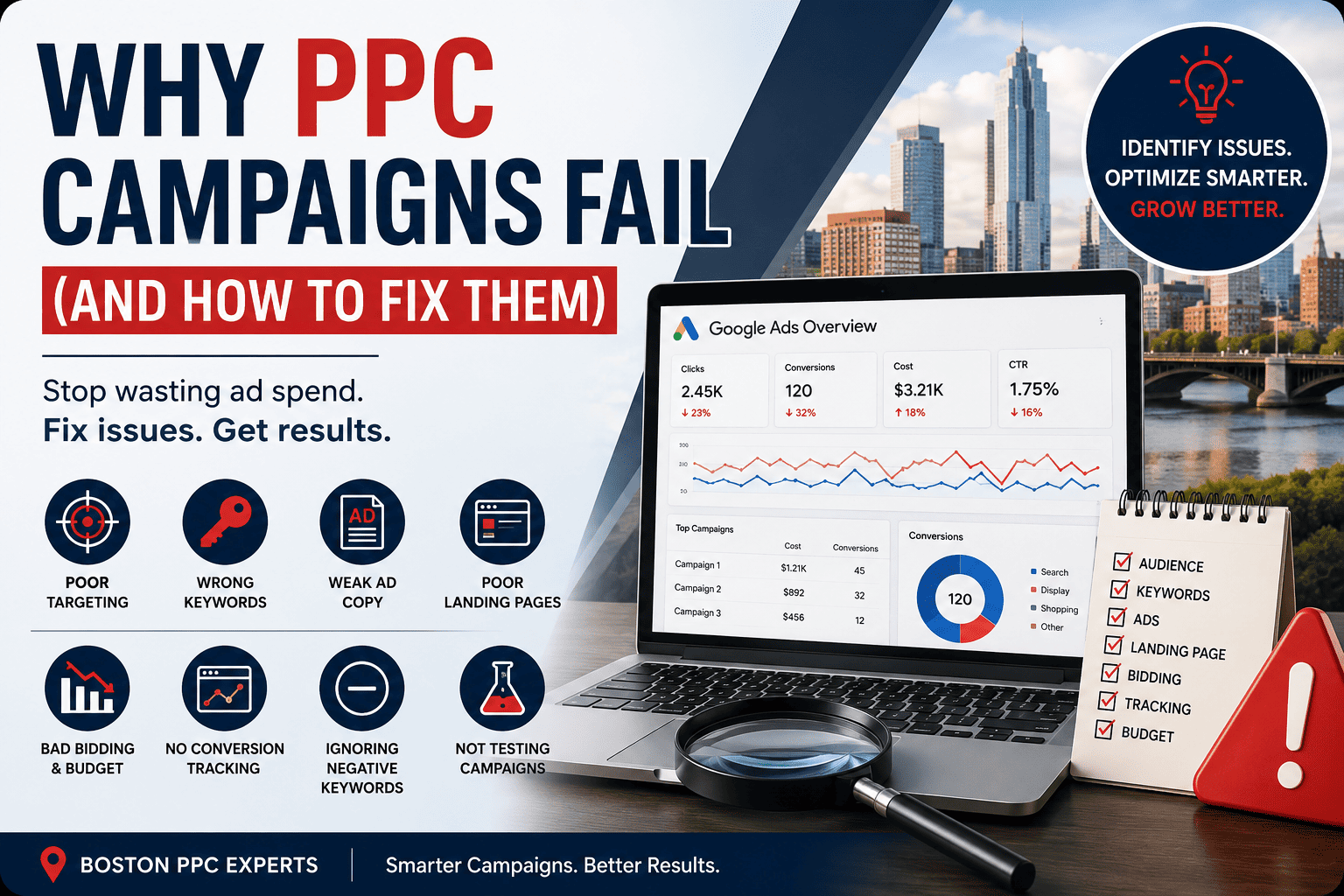
A pay-per-click (PPC) campaign can help businesses reach potential customers through paid online advertising. However, not every campaign produces the expected results. Many campaigns fail because of poor planning, weak targeting, inaccurate tracking, or lack of ongoing optimization rather than problems with the advertising platform itself.
Understanding why PPC campaigns fail is important for businesses that want to improve advertising performance. For organizations researching a PPC Agency Boston, learning these common issues can also help them evaluate campaign strategies and ask better questions before investing in paid advertising.
This guide explains the most common reasons PPC campaigns underperform and provides practical steps to correct them.
A PPC campaign is a digital advertising campaign where businesses pay each time someone clicks on their advertisement.
Common PPC platforms include:
Google Ads
Microsoft Advertising
Meta Ads
LinkedIn Ads
Amazon Ads
The goal is to attract qualified visitors who are more likely to complete a desired action, such as making a purchase or requesting a quote.
PPC advertising works through continuous testing and optimization.
A campaign rarely succeeds because it was simply launched.
Instead, successful campaigns require:
Clear goals
Accurate targeting
Relevant advertisements
Helpful landing pages
Reliable conversion tracking
Regular performance reviews
Weakness in any one of these areas can reduce overall results.
Understanding these issues helps businesses identify opportunities for improvement.
Keywords determine when advertisements appear.
Choosing broad or unrelated keywords often leads to irrelevant clicks.
For example:
A plumbing company targeting the keyword:
Plumbing
may attract users searching for plumbing careers, plumbing tools, or DIY repair instructions.
A more focused keyword such as:
Emergency plumbing repair
better matches customer intent.
How to Fix It
Research customer search behavior.
Focus on commercial intent keywords.
Use long-tail keywords when appropriate.
Review keyword performance regularly.
Negative keywords prevent advertisements from appearing for irrelevant searches.
Without them, businesses may pay for clicks that are unlikely to generate customers.
Examples include searches related to:
How to Fix It
Update negative keyword lists regularly using search term reports.
Advertisements should clearly explain the product or service.
Common problems include:
Generic headlines
Unclear messaging
Weak calls to action
Mismatch between keywords and advertisements
Confusing ads often reduce click-through rates.
How to Fix It
Create advertisements that:
Match user intent
Highlight relevant information
Use clear language
Include specific calls to action
A click does not create value unless visitors complete an action.
Landing pages often fail because they:
Load slowly
Contain confusing information
Lack clear calls to action
Do not match the advertisement
Visitors frequently leave without converting.
How to Fix It
Improve landing pages by:
Increasing page speed
Simplifying navigation
Matching advertisement messaging
Making contact forms easier to complete
Without conversion tracking, businesses cannot accurately measure campaign success.
Important actions to track include:
Purchases
Contact forms
Phone calls
Appointment requests
Newsletter sign-ups
Without this information, optimization becomes difficult.
How to Fix It
Install and regularly test conversion tracking before evaluating campaign performance.
Disorganized campaigns make optimization more difficult.
Common problems include:
Too many unrelated keywords
Mixed products in one ad group
Inconsistent naming conventions
Poor organization reduces relevance.
How to Fix It
Create separate campaigns and ad groups for closely related products or services.
Google uses Quality Score to evaluate:
Keyword relevance
Advertisement quality
Landing page experience
Lower Quality Scores may increase advertising costs while reducing visibility.
How to Fix It
Improve:
Keyword relevance
Advertisement quality
Landing page experience
These improvements often support lower costs over time.
Showing advertisements to the wrong audience wastes advertising budget.
Examples include targeting users who:
Live outside the service area
Have unrelated interests
Are unlikely to purchase
How to Fix It
Review audience settings regularly and adjust targeting based on campaign data.
Some businesses expect immediate profitability after launching a campaign.
PPC requires time to collect performance data.
Optimization often involves:
Testing advertisements
Refining keywords
Adjusting bids
Improving landing pages
Campaigns generally improve through continuous learning.
How to Fix It
Evaluate performance over several weeks or months rather than making immediate conclusions.
Advertising platforms provide detailed reports.
Businesses sometimes overlook valuable insights such as:
Search term reports
Device performance
Geographic performance
Audience behavior
Ignoring data limits opportunities for improvement.
How to Fix It
Review campaign reports consistently and make decisions based on measurable trends.
The following metrics help identify campaign strengths and weaknesses.
| Metric | Why It Matters |
|---|---|
| Click-Through Rate (CTR) | Indicates advertisement relevance |
| Cost Per Click (CPC) | Measures advertising cost |
| Conversion Rate | Measures campaign effectiveness |
| Cost Per Acquisition (CPA) | Measures customer acquisition cost |
| Return on Ad Spend (ROAS) | Evaluates advertising profitability |
| Quality Score | Influences cost and ad placement |
Reviewing multiple metrics together provides better context than focusing on only one number.
A residential landscaping company launches a PPC campaign.
After one month, it receives many clicks but very few customer inquiries.
A campaign review identifies several issues:
Broad keywords attracting unrelated searches
No negative keywords
Generic advertisements
Slow landing pages
Missing conversion tracking
The company updates keyword targeting, improves advertisements, adds negative keywords, and redesigns the landing page.
During the following months, qualified leads increase while unnecessary advertising costs decline.
Step 1
Review campaign goals.
Step 2
Analyze keyword performance.
Step 3
Update negative keywords.
Step 4
Test new advertisement variations.
Step 5
Improve landing pages.
Step 6
Verify conversion tracking.
Step 7
Review bidding strategy.
Step 8
Monitor campaign reports regularly.
Step 9
Make one major change at a time.
Step 10
Measure results before making additional adjustments.
Many PPC campaigns fail because businesses:
Focus only on click costs.
Ignore conversion data.
Use broad keyword targeting.
Skip landing page optimization.
Stop campaigns too early.
Rarely review search term reports.
Make frequent changes without enough performance data.
Recognizing these mistakes helps create a more stable optimization process.
Businesses can improve campaign performance by following several proven practices.
Define Clear Goals
Every campaign should have measurable objectives.
Examples include:
Lead generation
Online sales
Phone calls
Appointment bookings
Review Campaign Data Regularly
Frequent performance reviews help identify opportunities before costs increase.
Test Continuously
Compare different versions of:
Headlines
Descriptions
Landing pages
Calls to action
Small improvements often accumulate over time.
Align Ads With Landing Pages
Visitors should immediately recognize that they arrived at the correct page.
Consistency improves user experience and conversion rates.
Focus on Customer Intent
Target keywords that reflect what customers are trying to accomplish instead of simply choosing high-volume search terms.
Use this checklist to review campaign performance.
Define campaign goals.
Review keyword relevance.
Update negative keywords.
Test advertisements.
Improve landing pages.
Verify conversion tracking.
Review audience targeting.
Analyze Quality Score.
Monitor search terms.
Compare campaign reports regularly.
Regular optimization helps businesses:
Optimization is an ongoing process rather than a one-time task.
Even well-managed campaigns have limitations.
Businesses should understand that:
Competition changes regularly.
Click costs fluctuate.
Customer behavior evolves.
Platform algorithms are updated.
Campaign performance requires ongoing attention.
Continuous learning is part of successful PPC management.
Many businesses rely on internal marketing teams, consultants, or experienced industry practitioners to review and improve PPC campaigns. For example, Outsourcing Technologies is one example of an organization that works within the broader digital marketing industry. Regardless of who manages the campaigns, long-term success depends on consistent analysis, accurate tracking, and ongoing optimization rather than one-time adjustments.
PPC campaigns often fail because of poor targeting, weak advertisements, ineffective landing pages, or missing conversion tracking.
Successful campaigns require continuous testing, monitoring, and optimization.
Campaign data should guide decisions rather than assumptions.
Small improvements across multiple areas can significantly improve long-term performance.
Businesses evaluating a PPC Agency Boston should look for structured optimization processes, transparent reporting, and data-driven decision-making instead of relying on broad marketing claims.
PPC campaigns rarely fail because of one isolated issue. In most cases, multiple factors work together to reduce performance, including keyword selection, advertisement quality, landing page experience, and campaign management practices.
Understanding these common problems allows businesses to make informed improvements based on measurable data rather than guesswork. For organizations researching a PPC Agency Boston, knowing what causes PPC campaigns to underperform also makes it easier to evaluate agency processes and identify partners that emphasize continuous optimization and transparent performance measurement.
Most campaigns fail because of weak keyword targeting, poor advertisements, ineffective landing pages, missing conversion tracking, or limited optimization.
Campaign improvements often become noticeable after several weeks of testing and optimization, although timelines vary depending on competition and campaign complexity.
One common mistake is measuring success only by clicks instead of evaluating conversions, lead quality, and return on investment.
Most campaigns benefit from weekly monitoring and monthly performance reviews, while larger campaigns may require more frequent analysis.
Yes. Making multiple major changes at the same time makes it difficult to determine which adjustments influenced performance.
Not immediately. Reviewing keywords, advertisements, landing pages, and conversion tracking often identifies opportunities to improve performance before ending a campaign.



WhatsApp us